Tuesday, January 22, 2013
Removing guard petals from roses
Labels:
Floral Supply Syndicate,
guard petals,
Rose petals
Monday, December 31, 2012
Two new workshops with René van Rems for 2013
Kadomatsu
This is the last blog entry for 2012 so I thought I'd write something about a floral tradition which is used at the end of the year in Hawaii.
According to Wikipedia, the definition of Kadomatsu is:
A kadomatsu (門松?, literally "gate pine") is a traditional Japanese decoration of the New Year placed in pairs in front of homes to welcome ancestral spirits or kami of the harvest. They are placed after Christmas until January 7 (or January 15 during the Edo period) and are considered temporary housing (shintai) for kami. Designs for kadomatsu vary depending on region but are typically made of pine, bamboo, and sometimes ume tree sprigs which represent longevity, prosperity and steadfastness, respectively. "The fundamental function of the New Year ceremonies is to honor and receive the toshigami (deity), who will then bring a bountiful harvest for farmers and bestow the ancestors' blessing on everyone." After January 15 (or in many instances the 19th) the kadomatsu is burned to appease the kami or toshigami and release them.
In Hawaii, the tradition of gathering pine (as in leftover Xmas trees, wreaths, etc.) and bamboo (cut from the forest) come together to create floral arrangements called Kadomatsu. It is a very popular tradition whether you are Japanese or not. The arrangements are usually displayed right after Christmas.
We generally start with 3 pieces of bamboo graded in different heights and cut the top at a slant. These are usually bound together with cord, usually a rough, natural fiber and then they are set on a brick of floral foam and are surrounded by pieces of different kinds of pine.
After the addition of pine, you can add flowers, such as football mums, pompons, tropicals, anything which does not have thorns, such as roses. Further decoration such as ribbon, pine cones, tassels, etc. may be added at this point. Sorry, I neglected to take pics of these because I like it simple and organic with the pine and cedar.
Happy New Year to all, or as we say in Hawaiian, Hau'oli Makahiki Hou!!
According to Wikipedia, the definition of Kadomatsu is:
A kadomatsu (門松?, literally "gate pine") is a traditional Japanese decoration of the New Year placed in pairs in front of homes to welcome ancestral spirits or kami of the harvest. They are placed after Christmas until January 7 (or January 15 during the Edo period) and are considered temporary housing (shintai) for kami. Designs for kadomatsu vary depending on region but are typically made of pine, bamboo, and sometimes ume tree sprigs which represent longevity, prosperity and steadfastness, respectively. "The fundamental function of the New Year ceremonies is to honor and receive the toshigami (deity), who will then bring a bountiful harvest for farmers and bestow the ancestors' blessing on everyone." After January 15 (or in many instances the 19th) the kadomatsu is burned to appease the kami or toshigami and release them.
In Hawaii, the tradition of gathering pine (as in leftover Xmas trees, wreaths, etc.) and bamboo (cut from the forest) come together to create floral arrangements called Kadomatsu. It is a very popular tradition whether you are Japanese or not. The arrangements are usually displayed right after Christmas.
We generally start with 3 pieces of bamboo graded in different heights and cut the top at a slant. These are usually bound together with cord, usually a rough, natural fiber and then they are set on a brick of floral foam and are surrounded by pieces of different kinds of pine.
| Cut bamboo, tied and sitting on floral foam, waiting for pine. |
| Addition of pine. |
After the addition of pine, you can add flowers, such as football mums, pompons, tropicals, anything which does not have thorns, such as roses. Further decoration such as ribbon, pine cones, tassels, etc. may be added at this point. Sorry, I neglected to take pics of these because I like it simple and organic with the pine and cedar.
Happy New Year to all, or as we say in Hawaiian, Hau'oli Makahiki Hou!!
Tuesday, December 11, 2012
Creative Design Study Group with Hitomi Gilliam AIFD
Christmas workshop with René van Rems
Labels:
Christmas workshop,
René van Rems
Sunday, November 11, 2012
Hawaii Dept. of Agriculture's "Buy Local" event 11/4/12 in Pearl City, HI
| Pearl City Florist |
| Fujikami Florist |
| Fujikami Florist |
| Su-V Expressions |
| Su-V Expressions |
| Live feed from the auditorium into the multi-purpose room where novices were creating their own designs. |
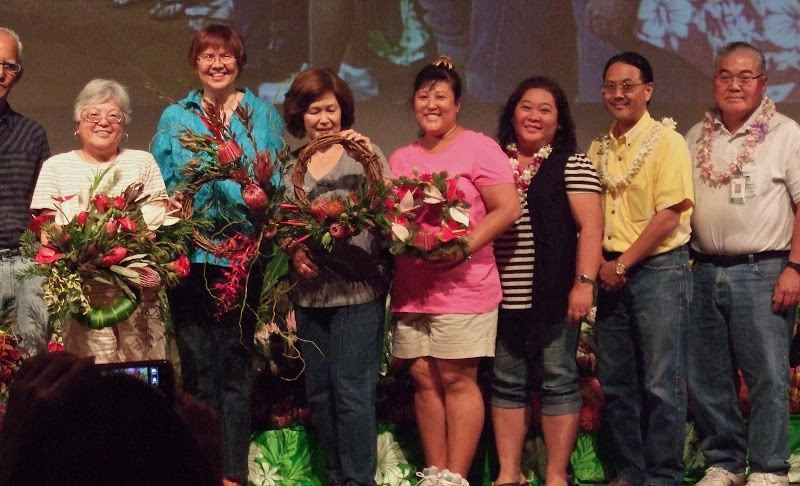
| A break from watching the professional designers to the wreath contest. Here are the participants with their designs. |
| The participants with the judges. |
| The professional designers began again and the Sogetsu group is on stage. |
| Flo's Min Florist |
| Flos's Min Florist |
![]() |
| The beginning of my segment. |
![]() |
| Our criteria was to design for the holidays. |
![]() |
| Thanking the growers for contributing their wonderful products. |
![]() |
| A door swag made of tropicals instead of wheat for Thanksgiving. |
![]() |
| An easily made intimate centerpiece using an Oasis wire collar, Oasis bind wire, Oasis cube gel, Oasis mega bead wire, oncidium orchids and curly willow in a fluted vase from Floradec Sales. |
![]() |
![]() |
| Using Christmas cones from Pier One, one is right side up and placed inside a dried grape vine wreath and the other is flipped upside down and used as a vessel for an inverse proportion arrangement. |
![]() |
| Mahalo Dept. of Ag for bringing awareness of floriculture to the public. |
Saturday, November 3, 2012
Thanksgiving workshop with René van Rems Nov. 19/20
|
|
|
Thanksgiving Workshops in Rene’s New Studio!
Let’s have a little “more” fun this holiday season and bring your fall party to the table! Join us in a relaxed setting for a Thanksgiving Centerpiece Class led by Rene van Rems.
Under Rene’s guidance, you will create your festive table-scape, setting the scene for fall entertaining. Give your typical tableaux a new twist by incorporating fall flowers and leaves, berries, nuts and all the trimmings in a hurricane glass harvest bounty centerpiece for an elongated or round table. Your fall colored centerpiece will last up to 2 weeks or so!
*Refreshments provided!
Class includes all materials. Please bring a floral knife & pruners.
Four Options:
Monday, November 19. 1:00 pm–4:00 pm OR 6:30 pm-9:30 pm
Tuesday, November 20. 1:00 pm–4:00 pm OR 6:30 pm-9:30 pm
$125.00 (includes tax and all materials)
Deadline for final registration Wednesday, November 14*
*PRE-REGISTER BY NOVEMBER 8TH AND JOIN US FOR $99 ONLY!
Rene van Rems International Studio/Holland Pacific Floral Training Center
5451 Avenida Encinas, Suite F
Carlsbad, CA 92008
To register, call 760 804 5800 or email rene@renevanrems.com
Labels:
Rene van Rems,
Thanksgiving workshop
Friday, November 2, 2012
Hawaii Dept. of Ag promotes "Buy Local for the Holidays"
'TIS THE SEASON TO BUY LOCAL FOR THE HOLIDAYS!!!
NR12-13 October 22, 2012
Free Make-and-Take Floral Arrangements Features Spectacular Flowers
Plus a Message to Help Protect Hawai`i
Sunday, November 4, 2012
9 a.m. to 2:30 p.m.
Pearl City Cultural Center and adjacent Pearl City High School Multipurpose Room,
2100 Ho`okiekie Street, Pearl City
The event is FREE to the public and will feature local floral designers creating gorgeous holiday arrangements using only locally grown flowers and foliage. Besides watching the professionals, the public will also have an opportunity to make-and-take their own local arrangements using their choice of flowers and foliage – for free. In addition, there will be a local wreath-making contest beginning at 11:30 a.m. and Hawai`i nurseries will have plants for sale and 200 lucky people will get a free local potted plant.
The event is part of HDOA’s Buy Local, It Matters campaign, which encourages consumers to support local farmers and growers by making conscious decisions to buy local whenever possible. In addition, this particular event emphasizes that by buying local, we can also reduce the amount of imported flowers, thus reducing the amount of invasive plant pests and diseases entering our state.
“It’s really amazing to see people have fun while using locally grown flowers to make beautiful arrangements,” said Carol Okada, manager of HDOA’s Plant Quarantine Branch. “We invite everyone, including women, men and keiki, to come down and make their own local creation.”
HDOA and the local nursery industry will provide hundreds of locally grown flowers and foliage including: anthuriums, orchids, protea, heliconia, ginger, bird of paradise, palms and much more.
“The nursery industry in Hawai`i relies on the strong support of the local community,“ said Russell S. Kokubun, chair of the Hawai‘i Department of Agriculture. “Purchasing locally grown florals also helps to reduce the amount of imported products that carry hitchhiking pests and plant diseases into our state.”
Floral designers participating in the event include: Alluvion Inc., Pearl City Florist, Fujikami Florist, Flo Min Florist, Ambiance Today and more.
Once an invasive pest or disease becomes established in Hawai`i, it may have a devastating impact on Hawai`i agriculture by causing damage to crops and is often costly for the state and growers to control. Invasive species may also harm Hawai`i’s unique ecosystem.
###
To view the Buy Local for the Holidays Flyer, click here.
Tuesday, October 30, 2012
Flower Talk: Pollen Disasters!
Great tip from Sun Valley's blog:
Flower Talk: Pollen Disasters!: One of the most eye catching elements of a lily is the colorful pollen which coats the stamens of the flower. The pollen and stamens provide...
Flower Talk: Rene van Rems' 25 Top Bridal Bouquet Styles
Flower Talk: Rene van Rems' 25 Top Bridal Bouquet Styles: Today's blog post takes a slight departure from my usual adventures in floral education. Rather than a flower, I'm talking about a book (...
Monday, October 22, 2012
Hawaii Dept. of Ag. sponsoring "BUY LOCAL" event on Nov. 4, 2012
Labels:
Ambiancce Today,
Buy Local,
HDOA,
tropical flowers
Tuesday, October 16, 2012
Friday, October 12, 2012
Sunday, October 7, 2012
Floralife Research - Hydrangeas

August 2012
Floralife, a division of Smithers-Oasis Company
Oasis® Maxlife Combined with Floralife® Flower Food Clear 300
Prolongs the life of cut hydrangea
Background
Few cut flowers provide a greater visual impact than Hydrangeas, contrasting a large but delicate floral display with lush green foliage. Unfortunately, the large number of individual flowers, high foliage surface area, and thick woody stems make them an easy target for premature wilting. Cut Hydrangeas have a reputation of lasting only a few days in a vase or floral foam arrangements when using plain water particularly if adequate hydration is not maintained.

Our previous studies have shown that OASIS® Floral Foam Maxlife prolongs the life of Gerbera Daisy, another cut flower with a poor reputation in foam arrangements due to challenges with hydration. Based on these results we wanted to evaluate the performance of cut Hydrangeas in OASIS® Floral Foam Maxlife. In addition, we wanted to see how the Hydrangeas performed in OASIS® Floral Foam Maxlife soaked in plain water vs. how it performed soaked in a solution of Floralife® Flower Food Clear 300.
Methods
-
1. White Hydrangeas were received from a local wholesaler.
2. All stems were recut on arrival and placed in tap water (60 ppm alkalinity) in the flower cooler (2 degrees C) for 24 hours.
3. For the foam treatment, OASIS® Floral Foam Maxlife bricks were soaked in either:
-
a. Plain tap water (120 ppm alkalinity)
b. A solution made with Floralife® Flower Food Clear 300
(note: Both foams were placed in design trays)
5. Design tray reservoirs were filled with the treatment soak solutions at the beginning of the study, but no additional solution was added for the remainder of the test.
6. For vase treatments, we prepared:
-
a. A vase with 500 ml of plain water.
b. A vase with 1 L properly dosed solution of Flower Food 300 and water.
8. Vase and foam treatments were placed on tables in the postharvest lab in a completely randomized design (12 hours of fluorescent lighting at a constant temperature of 20 degrees C).
9. Flower life (in days) was determined subjectively when wilting was clearly visible.
10. Each foam and vase treatment was repeated 3 times with each repetition containing 3 stems.
11. Flower life averages were determined for each treatment and analyzed using Statistica Software to determine statistical significance.
Results and Discussion
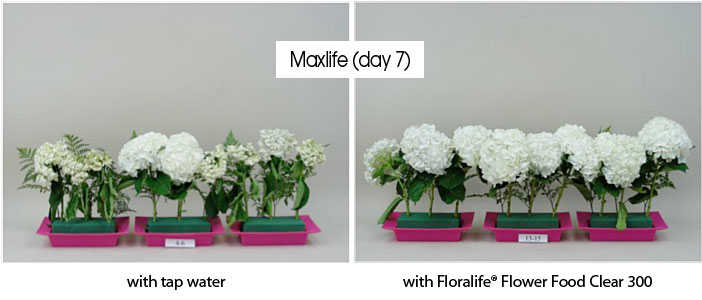
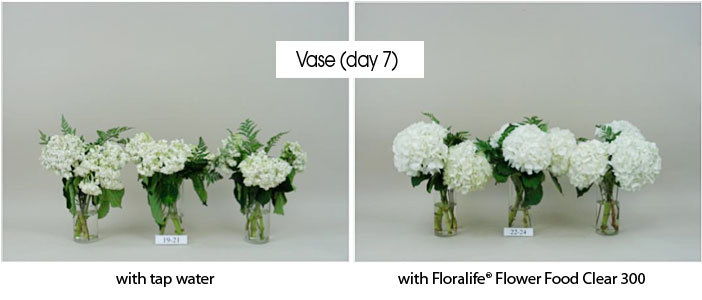
Floralife® Flower Food Clear 300 significantly increased flower life in the vase and OASIS® Floral Foam Maxlife treatments. Results indicate that cut Hydrangeas are very responsive to flower food and it is speculated that the Maxlife technology helps facilitate the uptake of flower food in the floral foam arrangement. This study demonstrates that cut Hydrangeas can last an average of 8 days in a floral foam arrangement when combining OASIS® Floral Foam Maxlife and Floralife® Flower Food Clear 300 technologies.

Conclusion
OASIS® Floral Foam Maxlife saturated in Floralife® Flower Food Clear 300 resulted in an average flower life of 8 days compared to only 4.5 days in Maxlife + plain tap water. The Maxlife + Flower Food Clear 300 treatment performed as well statistically with flower food in a vase even though no additional water was added to the foam treatments.
Note: For best results on getting fully saturated foam, always place foam in the soaking solution broad side down with the imprinted logo on the top surface. This is because the foam cell structure is such that it soaks best from the bottom up.


Labels:
Floralife,
hydraangeas,
Maxlife,
Smithers-Oasis
Thursday, October 4, 2012
Phil Rulloda AIFD at Cali Flora
Subscribe to:
Posts (Atom)